1441 stories
·
0 followers

Hackers Are Exploiting Recently Patched WordPress Bugs, Putting Millions of Websites at Risk

1 Share
An anonymous reader quotes a report from TechCrunch: Hackers are breaking into websites that run vulnerable versions of the popular blogging software WordPress, according to several cybersecurity firms. One estimate puts the number of vulnerable WordPress websites at tens of millions as of Monday. Last week, WordPress patched two critical security flaws, urging people who run its software on their websites to update it "immediately." The vulnerabilities are so severe that WordPress enabled forced updates where possible. Since then, cybersecurity companies Patchstack, Hexastrike, and WatchTowr have all warned that hackers are exploiting the vulnerabilities in the wild, meaning they are taking over websites that are still running susceptible versions of WordPress. It's unclear how many WordPress-powered websites on the internet are at risk, but it's possible to make some educated guesses. The vulnerable versions of WordPress are 6.9.0 through 6.9.4, and 7.0.0 to 7.0.1. According to WordPress' official stats, there are more than 400 million websites that run those flawed versions, although these statistics likely don't reflect websites that have recently been patched. Cybersecurity consultant Daniel Card, who told TechCrunch that he looked at a sample of around 3,500 WordPress websites, estimates that less than 15% are vulnerable. Applying Card's projection across the total population of WordPress websites on the internet, the total figure would still be around 90 million. [...] One of the critical WordPress bugs was found and reported by Adam Kues of cybersecurity firm Searchlight Cyber, which dubbed it WP2Shell. Paired with the other bug, hackers can take full remote control of vulnerable websites.

Read more of this story at Slashdot.

Read the whole story
Share this story
Delete

The first UL 3700-compliant plug-in solar microinverter is now available in the US

1 Share
It's a step toward making alternative energy accessible on a smaller, renter-friendly scale.

Read the whole story
Share this story
Delete

NRC is (sort of) getting rid of "as low as reasonably achievable" standard

1 Share

Last week, just before the US started its break for the July Fourth holiday, the Nuclear Regulatory Commission (NRC) proposed a new rule that would change how it regulated exposure to radiation. The Trump administration has been pushing to restart construction of nuclear power plants in the US, and many pro-nuclear advocates have been complaining about the US's existing regulations, portraying them as the main barrier to the flourishing of the industry. So, it had seemed likely that major revisions were coming.

Instead, the NRC's proposed new rules endorse the science behind its current rules and suggest that any problems are largely in the vagueness of the terminology that it has been using. So, instead, it's endorsing standards that are meant to accomplish the same thing, but avoid using some of the language it had relied on. Probably the clearest indication of the evolutionary change at play is that the NRC estimates the changing rules will save industry—not just power, but also medical and research applications—only about $9.5 million a year.

LNT and ALARA

There are two technical abbreviations at the center of US nuclear regulations. The first is LNT, which stands for "linear non-threshold." It's in reference to the issue of whether there's any level of radiation that is so low that it no longer produces harmful biological effects—the "threshold" in LNT. The "non-threshold" implies that it doesn't, and that's in keeping with biology, which has demonstrated that even single particles or photons of radiation can damage DNA and that the mechanisms cells have for repairing that damage are inherently error-prone. The "linear" in LNT simply describes how the impact of radiation scales directly with the dose.

Despite the solid foundation in basic biology, LNT has been difficult to demonstrate in the real world. Humans are exposed to many factors that can influence the development of cancer, including naturally occurring radiation. Teasing out the impact of a small dose of radiation that occurs in addition to all those other exposures is extremely challenging, and the impact of extremely low exposures has not been decisively demonstrated.

Complicating matters, a number of people have advocated for something called hormesis, in which small doses of radiation purportedly promote the cellular repair of damage from other sources. The evidence for this is even spottier, and when the NRC was petitioned to adopt hormesis as part of its scientific framework during Trump's first term, it rejected the petition.

Given its acceptance of an LNT model of exposure risks, the NRC had chosen exposure standards that fell under the general term of ALARA: as low as reasonably achievable. If any exposure to radiation poses a risk, then minimizing it is the clearest way to protect the health of people who work with radioactive substances. The challenge there is that it's possible to set exposure limits that people outside the industry regularly exceed each time they board a commercial aircraft.

So, the word "reasonable" plays an outsized role while remaining highly subjective. Critics have charged that it precipitates an endless cycle of reasonable exposure limits leading to searches for additional ways to lower them further, or of adoption without cost considerations. And here, the NRC is acknowledging that there have been issues. "In essence, the reasonableness test that is supposed to be inherent to ALARA-related decision-making has gradually become an expectation that if a means of dose reduction is available, regardless of its reasonableness in relation to the total dose and the amount of reduction, it should be applied without further consideration," its new proposal suggests.

In the past, the NRC has attempted to address this by attaching a financial value to each unit of exposure based on estimates of the value of healthy life developed elsewhere. But in the new proposal, it accepts that "there have been challenges in the implementation of the ALARA requirement, namely a lack of clarity of when dose reduction is deemed sufficient, excessive subjectivity, and susceptibility for selective or inconsistent enforcement." So, it's giving up on a term that it now views as a source of confusion.

What's different

One of the key things here is that the LNT model of exposure risks isn't going away. In its earlier denial of petitions that it change its standards, the NRC had concluded that "in the absence of convincing evidence that there is a dose threshold or that the health effects of low levels of radiation are fully understood, the LNT model for cancers and genetic effects was appropriate for formulating radiation protection standards and planning radiation protection programs." In the proposed new rules, that logic is left intact. "The NRC finds that no consensus-supported, regulation-ready alternative model to the LNT model exists at this time," it states.

More specifically, it states, "It is unlikely there might be a threshold level of exposure below which biological response does not occur. Such a threshold could only occur if DNA repair processes were totally effective in that dose range or if a single radiation track were unable to produce an effect."

It's worth noting that the NRC is making that decision despite the fact that Trump issued an executive order that describes LNT and then calls it irrational. "The NRC utilizes safety models that posit there is no safe threshold of radiation exposure and that harm is directly proportional to the amount of exposure," the order reads. "Those models lack sound scientific basis and produce irrational results." The agency is keeping LNT in place despite being specifically ordered to reconsider it.

With LNT intact, the scientific backing for ALARA remains in place. So, the new proposed regulations largely focus on calling it something else. "The NRC proposes to remove references to the ALARA principle, which rests on the LNT model’s assessment of risks from very low doses of radiation, from its regulations," the proposed changes say. "Instead, the NRC would apply a less-subjective, graded approach to managing doses below regulatory limits."

To replace ALARA, the NRC will start with a limit at which evidence clearly indicates radiation impacts would be apparent and set exposure thresholds below that. From lowest to highest exposure, these thresholds will require increasingly aggressive efforts to limit exposures.

The language of the details is a bit confused, however. As its name implies, the LNT model suggests there are no thresholds below which biological risks go away, and the NRC accepts that model. Yet it's regulated based on thresholds. It's also referring to those thresholds as an implementation of an "optimization" approach to safety. But it also quotes a definition of optimization that refers to it as a form of ALARA—which, again, is a term that the NRC wants to get rid of.

Beyond that action, the rule changes the NRC is proposing largely focus on updating regulations on the use of equipment to monitor exposures. Technology has advanced since the agency last modified its requirements there, and it's using this proposal to update them accordingly.

Number crunching

Regardless of the confusion, it's clear that the changes aren't going to cause the sort of boom in nuclear power that the Trump administration expected in its executive order. One of the key features of the planned rules is that any organization that's currently in compliance will remain that way without making any changes. Changes will only make sense if an organization thinks it can save money by adopting them.

And, as noted above, those savings for industry will be pretty minimal, with the total estimated at $9.5 million a year. Even if we assume that these savings go only to nuclear power and are ascribed only to dropping ALARA (as opposed to cheaper exposure monitoring, for example), spread out across the 57 nuclear plants in the US, that means just an average savings of a bit over $150,000 per plant.

So, those who viewed ALARA as the cause of all the nuclear industry's woes will likely be excited to see the NRC eliminate it. But they'll also be disappointed to find that its scientific foundations remain intact, and the regulatory environment will be minimally changed as a result.

Read full article

Comments



Read the whole story
Share this story
Delete

FCC to repeal 39% TV ownership cap in boost for Trump-friendly news orgs

1 Share

The Federal Communications Commission will vote to repeal the National Television Ownership Rule that is supposed to prevent a single broadcast station owner from reaching more than 39 percent of all TV households in the US. The proposed change sets up a likely court battle over the FCC claim that it has authority to repeal a limit set by Congress.

FCC Chairman Brendan Carr has already treated the rule as more of a suggestion. In March, the Carr FCC granted a waiver allowing Nexstar Media Group to buy Tegna in a deal that let it reach over half of TV households. The Carr FCC argued that Congress gave it authority to modify or waive the rule.

Carr now plans to repeal the 39 percent limit and replace it with a "case-by-case review" of each proposed merger, the chairman announced today in an op-ed published on Breitbart. The change would make it easier for the FCC to pick and choose which station groups get to surpass the limit. Under Carr, this would likely benefit news companies that provide favorable coverage for President Trump.

"Americans no longer trust the legacy national media to report the news fairly or accurately," Carr wrote in Breitbart, noting that trust of media "is even lower among Republicans." Carr alleged that many local broadcast TV stations are "turning into little more than mouthpieces for programming produced in New York and Hollywood."

Gomez: Plan benefits Trump's "billionaire buddies"

Last year, when Carr threatened ABC affiliates with license revocations for carrying Jimmy Kimmel’s show, he said that national networks exert too much control over local TV stations and that he’s trying “to empower local TV stations to serve the needs of the local communities.” Carr has praised Trump for "fundamentally reshaping the media landscape," and used his post at the FCC to exert pressure on news organizations that Trump doesn't like. Nexstar helped Carr's campaign against Kimmel by temporarily refusing to air the show on its stations.

Commissioner Anna Gomez, the only Democrat on the three-member FCC, today called Carr's plan an "unlawful effort to hand control of the public airwaves to billionaire buddies of this administration." She said it "will destroy local newsrooms, silence community reporting, and drive up costs for the American families who depend on local stations for news and emergency alerts." Without the 39 percent cap, "this FCC is now poised to allow local broadcasters to sell those airwaves off to the highest bidder," Gomez said.

A press release issued by the FCC chairman's office said that case-by-case reviews will allow mergers to exceed the 39 percent limit if the deal advances "localism, viewpoint diversity, and competition." Carr wrote in his Breitbart op-ed that there has been "a steady decline in locally produced news" that would be fixed by letting companies own larger numbers of stations. The current rule prevents local broadcasters from achieving the scale in operations they need to challenge competitors, he argued.

"When it comes to broadcast news, our country could do with a little less Hollywood and a little more local reporting from communities across the country," Carr wrote in Breitbart. "The FCC’s plan to switch from a national cap to a case-by-case review allows exactly that and shifts the focus back to the American people and the local communities they live in."

Only Congress can change cap, critics say

The planned change, set to be voted on at the commission's August 6 meeting, is certain to face legal challenges. Only Congress can change the ownership cap, Gomez and other critics of Carr say.

"Congress set the 39 percent national ownership cap in federal law, and only Congress has the authority to raise or eliminate it. The commission cannot waive away that limit simply because these corporate behemoths want to get out from under it," Gomez said.

Gomez said the FCC tried and failed to change the cap over 20 years ago. "In 2003, the Commission raised the cap to 45 percent under its own authority," she said. "Congress stepped in within months, rewrote the law to set the cap at 39 percent, and made clear the FCC did not have the authority to change it. An FCC vote to raise the cap now would be unlawful, as it would mean doing the exact thing Congress has already said the Commission cannot do."

Gomez was referring to a 2004 vote in which Congress amended the Telecommunications Act of 1996 to require the FCC to enforce a cap of 39 percent.

FCC accused of illegally waiving limit for Nexstar

The FCC was previously accused of exceeding its authority when it gave Nexstar a waiver that let it complete its Tegna deal. The FCC cannot legally waive the 39 percent limit because Congress "amended Section 202 of the Telecommunications Act of 1996 to specifically bar the agency from granting waivers to the 39 percent cap Congress likewise dictated," said a December 2025 FCC filing submitted by The United Church of Christ Media Justice Ministry, Public Knowledge, Free Press, and the Communications Workers of America.

Nexstar now reaches 54.5 percent of households when calculated with the “UHF discount,” in which only half of the households reached by a UHF station are counted. Without the UHF-specific calculation, Nexstar's reach grew from 70 percent to 80 percent when it bought Tegna.

The Carr FCC said that Congress instructed it to set the 39 percent cap “through its rulemaking authority, which necessarily leaves the agency with the discretion to modify or waive its rules.” Nexstar completed the Tegna acquisition on March 19, but a federal judge ordered the merging companies to stop integrating their assets and operations while an antitrust case brought by DirecTV proceeds. Nexstar is appealing the ruling.

Carr's plan to eliminate the 39 percent cap is supported by Nexstar and the primary lobby group for broadcasters. Nexstar said today that "no one would suggest limiting the reach of YouTube, Amazon, or CNN, yet local broadcasters are still forced to compete under rules written for a different century. Modernizing these outdated regulations will help ensure broadcasters can continue investing in local journalism and providing the free, trusted news and information that communities across America rely on every day."

The National Association of Broadcasters similarly said that "decades-old ownership restrictions that apply only to broadcasters—and none of our competitors—are out of step with today’s media marketplace."

Read full article

Comments


Read the whole story
Share this story
Delete

On America's 250th, more cities used drone surveillance to spot illegal fireworks

1 Share

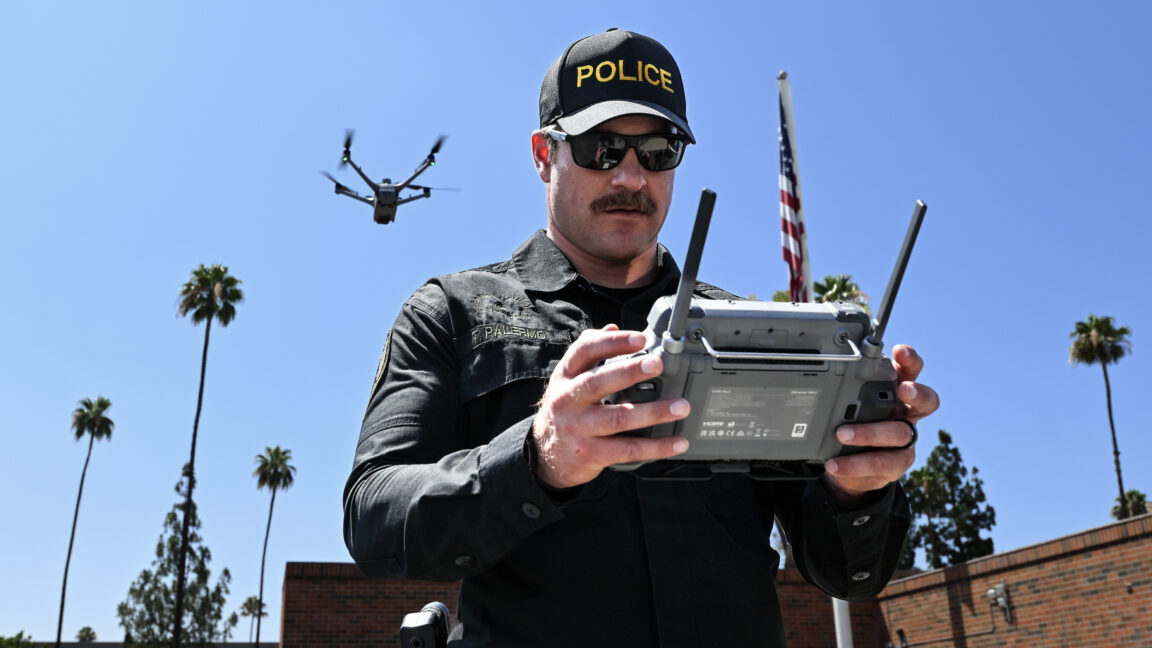
More cities and towns deployed drones to spot illegal fireworks during the Fourth of July celebrations commemorating America’s 250th anniversary—leading to a $100,000 fine in one instance and coming as part of a broader national trend of first responders turning to drone surveillance.

Police and fire departments have described using both increased drone surveillance and steep fines to deter people from shooting off illegal fireworks, with many departments publicizing their drone videos on social media and warning that their drones will be watching in the future. Incidents involving illegal fireworks have led to costly fires, injuries, and even multiple deaths each year, along with creating local air and noise pollution for residential neighborhoods.

This year, the $100,000 fine for illegal fireworks came from the Sacramento Fire Department in Northern California deploying its own drones for the first time on the Fourth of July, according to CBS News Sacramento. Sacramento Fire Captain Justin Sylvia described the fire department’s drones as being capable of recording scenes in high-resolution video to help investigators identify the house or closest location using Google Maps.

Such drone capabilities allowed the fire department to count the fireworks being fired from a gathering near a home in the Del Paso Heights neighborhood of Sacramento, according to the TV news station KCRA 3. The drone also showed a U-Haul trailer containing fireworks catching fire at one point, although the people at the gathering managed to put it out.

The resulting $100,000 fine came from counting the number of fireworks and possibly other factors. Sacramento County assigns fines for illegal fireworks starting at $1,000 per device and as high as $10,000 per device used near sensitive areas such as schools or parks. But felony criminal charges punishable by imprisonment are also possible if illegal fireworks cause a fire that leads to property damage or bodily injury.

The Sacramento Fire Department issued 70 citations on July 4, totaling $300,000 in fines. But the department was also looking to assign additional citations on July 2 and July 3. Sylvia told KCRA 3 that the department had previously issued a $1 million fine to a single individual in 2025.

In Central California, the Salinas Fire Department posted a promotional sizzle reel to Instagram featuring drone footage of various illegal fireworks activities and warning that it expected to issue nearly 100 citations from the Fourth of July weekend. The department first began training a dozen of its firefighters to become certified drone pilots in 2022, Monterey County Now reported.

The trend of first responders deploying drones has accelerated significantly since 2025, when the US Federal Aviation Administration reworked its regulations to enable faster approvals of waivers enabling police and fire departments to fly drones beyond the operator's visual line of sight.

Sacramento Fire’s drones crack down on illegal fireworks.

Unleash the drone sizzle reels

Several police departments in Southern California also deployed drone teams for the first time in 2026 to identify the locations of illegal fireworks activity. The Anaheim Police Department used drones to help issue 40 citations and confiscate 2,500 pounds of illegal fireworks, according to The Orange County Register.

The newspaper also confirmed that the Santa Ana Police Department deployed drones for the first time this year. The drones assisted the department in issuing 107 citations—though the citations were issued to property owners at addresses where illegal fireworks activity took place rather than to specific perpetrators.

The Santa Ana Police Department further claimed that its drone operators assisted in the seizure of nearly 1,300 pounds of illegal fireworks in a promotional reel posted to social media, which played the “Bad Boys” music of the American TV show Cops as the soundtrack.

Meanwhile, the La Habra Police Department posted a less flashy video to Facebook showing a drone video of a person lighting a firework in the middle of a residential street. It described its drone unit as helping with the issuance of “numerous citations” and leading to arrests in some cases for fireworks violations.

The Riverside Police Department has attributed its increase in citations for illegal fireworks to having deployed drones starting in 2025, according to the Los Angeles Times. The newspaper also listed other California cities such as Downey, Artesia, Brea, San Bernardino, Stanton, Chino, Hemet, and San Jose as deploying drones over the Fourth of July holiday.

California cities may be the most aggressive in using drones to hunt down illegal fireworks so far, but there are examples elsewhere. This year, the Lewisville Police Department in Texas shared footage with CBS News of its drone responding to 19 fireworks incidents on July 4, and reported several instances in which people firing off fireworks decided to stop and clear out once the drone arrived.

Washington state's Renton Police Department also posted drone video from this past Fourth of July weekend and has deployed drones for the past three years to spot people setting off illegal fireworks in the suburb of Seattle, according to MyNorthwest.

This all fits a broader trend of “drone as first responder” programs growing across the United States, as tech companies pitch law enforcement on drones equipped with a variety of surveillance capabilities. More than 1,800 police departments and sheriff’s offices have operated drones in the United States, according to the Electronic Frontier Foundation’s Atlas of Surveillance database. Such drones "should require clear policies around retention, audits, and use, including when the cameras shouldn't be recording," according to Beryl Lipton, a senior investigative researcher at the Electronic Frontier Foundation.

Incidentally, some US communities used drones on America’s 250th anniversary for a very different purpose—supplementing or even replacing official fireworks displays with drone swarms that put on coordinated and colorful shows in the sky. Such displays are both cleaner and quieter than fireworks, while significantly lowering the risk of starting fires in dry summer conditions.

Read full article

Comments


Read the whole story
Share this story
Delete

"We cannot choose to become idiots": The AI cheating scandal roiling Brown University

1 Share

Ivy League college students are, by definition, intelligent. They don't need to use generative AI to cheat on exams; they could just learn the material. But they also tend to be competitive, ambitious, and overscheduled, so AI can look like an easy shortcut that makes more time in their lives for things that can't be done by a chatbot. When the pressure is on, which approach do they choose?

A new scandal at Brown University reveals that huge numbers of these students are likely to cheat.

Record scores

A recent survey of Princeton students found that 29.9 percent admitted to cheating with AI on at least one exam or assignment. But the recent situation at Brown gives us a better sense of what this kind of cheating looks like in one particular class—and just how much it may be substituting for actual learning. And we know all this because the blind economics professor at the center of it all, Roberto Serrano, is not letting it go.

In just the last week, Serrano—who was born in Spain—has told his story to El País and Inside Higher Ed, which have both run significant pieces on the scandal.

The story that Serrano told them begins in December 2025, when a gunman attacked Brown's campus and killed two people, including one who had recently introduced herself to Serrano.

Roberto Serrano receiving an award from the King of Spain in 2025. Credit: Getty Images

Shaken by the experience, Serrano decided that his spring 2026 section of the quite difficult ECON 1170 would allow take-home exams for both the midterm and the final. Suddenly, the course received an influx of students. El País has the story:

The course... typically attracts few students, but very good ones. [Serrano] has never had more than 30 students enrolled at a time, and on some occasions he had only eight. This semester, probably because of the new evaluation system, 86 students signed up for the class. The results of the midterm exam, which was administered on March 5, were extraordinary, with an average score of 96 out of 100. Forty students scored a perfect 100.

This was indeed extraordinary, because as Serrano told Inside Higher Ed, "Historically the average grade in the midterm of this course has ranged between 65 and 80 [percent], and this exam was harder than the exams I wrote in the past, because... take-home is an opportunity to challenge the class a little bit more, given that you’re giving the students unlimited time."

Beyond the numbers, many of the answers, even when correct, felt slightly off. They had a "very convoluted style," Serrano said. When he and his grad students ran the exam questions through ChatGPT, they received similar results.

A suspicious Serrano decided that he would make the final exam in-person; he would see if students did similarly well on it. He emailed his class, telling them, "I am not declaring [the midterm] void for now. I am going to give the class a chance to prove me wrong. That is, if the distribution of the final exam is roughly similar to the distribution of the midterm, I will count the midterm. Otherwise, which is of course what I expect to happen, I will declare the midterm void and reweigh the final accordingly."

Eighteen students suddenly dropped the course, while nine others didn't even attend the final exam. Of those 27 students, El País noted, "22 had scored a perfect 100 in the midterm exam."

Among those who took the test, the average score plunged—from 96 all the way down to 48.

A failed society?

The professor was horrified by what appeared to be massive cheating in his course—cheating that was preventing most of the students from learning the material.

Serrano comes across as someone with no inclination to coddle elite students. His attitude may be traceable in part to his own childhood, in which he went blind from retinal dystrophy at age 17 and had to make a choice about what the rest of his life would look like. From El País:

After a short-lived crisis, he decided [blindness] would not stop him. He learned Braille, and his excellent academic record opened up the doors of Harvard. “Of course it affects my life, but one shouldn’t over-dramatize. We economists understand reality as a set of people responding to optimization problems with restrictions. I view my disease simply as one more restriction that I have to deal with, and I optimize based on that,” he says.

As a university, Brown is grappling with hard questions about AI use at the moment. It recently released a provost-led report (PDF) on "Generative AI in Teaching and Learning," which found that it's not just professors who have concerns.

Even though "56 percent of undergraduate respondents [at Brown] and 67 percent of graduate and medical student respondents reported intentionally using GenAI tools daily or weekly," the report notes that large majorities of students also have "concerns about the impact of GenAI use on their learning" and a "fear of negative consequences for their cognitive capacity."

Serrano shares those concerns, and he wants universities as a whole to stand up for human thought. That's why he's not letting this story go, despite what he contends is a fairly tepid reaction from Brown administrators.

"We cannot afford to have a society in which a significant fraction of our best young minds think that cheating is okay,” he told Inside Higher Ed. “That leads to a declining society, to a failed society.

"We cannot choose to become idiots.”

Read full article

Comments


Read the whole story
Share this story
Delete
Next Page of Stories